Sunday, October 4, 2015

Economic and reliable sea freight solutions

Are your ocean freight requirements designed around what's best for your individual business needs? At SRMF, we act as consultants, guiding and advising on all elements of the supply chain service, partnering with our customers by achieving an in depth understanding of their requirements.
We provide multiple solutions for ocean freight movements in all major ocean trade lanes, dealing with major carriers on global routes to ensure the availability of space and equipment exactly when you need it.

We offer a complete package of cost effective delivery solutions to match your global supply chain needs:
+Worldwide Ocean Imports & Exports (FCL/LCL) options
-Door/Door
-Door/Port
-Port/Door
-Port/Port
-Buyers Consolidation
+Worldwide Ocean Cross-trade Movements (FCL/LCL)
+Consular Documentation & Legalization Serviaces
+Customs Broker/Brokerage
+Out of Gauge and Project Shipment
+Global agency network

Our dedicated sea freight team will manage all your requirement from pickup point through to final destination, you can rest assured that your cargo is in safe hands.
We work with a network of renowned partners, operation from strategic global locations ensuring we can provide the local knowledge so necessary to deliver a smooth supply chain flow at a cost effective price.

Flow of information is vital in any trade. At SRMF your dedicated Freight Consultant will keep you informed at every step of the process, from collection through to final delivery.

Tuesday, September 15, 2015

ENSURE YOU ONLY PAY WHAT IS RIGHT.


Everyone says they want to improve their bottom line, they are tired of paying too much for their landed costs but don’t change because change means that they have to tell their current supplier that they are tired of being ripped off. So what do they do? They benchmark against other service providers and all of a sudden, they get big discount.


It's not discount, it is proof that you are being ripped off, it is time to stop this and change to the company that will ensure you only pay what is right..


We offer a comprehensive logistics solutions that manages all forms of transport from road and rail to sea and air. Our  purpose-built for our clients and prospective clients, ensuring that every aspect of the transport process is suited to their specific needs.

Always bring good quality content to customer more than just making money. We deliver the good resource to customer, and solve their problem.

Tuesday, September 8, 2015

Logistics as a competitive Weapon

Logistics can create a Competitive Advantage. Logistics may be the best source of competitive advantage for a firm because it is less easily duplicated than other elements of the marketing mix: product, price, and promotion. Consider, for example, forming close, ongoing relationship with carriers or logistics services providers can help give the firm a distinct competitive advantage in speed to the customer, reliability, availability, or other customer service factors.

The power of logistics in achieving an organization's customer service goals and supporting customer satisfaction has received an increased amount of attention in the press. Companies that understand and utilize the potential of logistics as a competitive weapon include logistics as a key component of their strategic planning process. In recognition of the key role of logistics in supporting strategic customer service initiatives.

 I Just want to extract your attention  back to  the succeed military logisticians  "ALEXANDER THE GREAT and Wasn’t THE GREAT ...... LOGISTICIAN !!" he has a famous quote for the logisticians which still carries a lot weight today. He said “My logisticians are a humorless lot … they know if my campaign fails, they are the first ones I will slay.”  I love this quote because it captures the do or die nature of logistics with a funny, but morbid twist. While managers are no longer killing logistics guys, there is still a lot of pressure on the logistics function. 


Why Wasn’t That Great

The problem with Alexander’s management style is that it leads to the wrong behaviors. When the logistics guy is risking his life every time the army falls short, I’m guessing there was a lot of finger pointing, CYA and plain old lying going on.
In such an environment, team work, honesty, morale, and trying out new ideas, were probably in short supply.
The same thing happens today. If the logistics guy is going to be beat up for every problem, they will begin to withhold bad news, cover up issues and shift blame to someone else. When problems get covered up, they obviously don’t get solved.

Open Communication and No Executions

To get the most from your logistics group, you have to develop a culture that encourages open communication and continuous improvement
The foundation of that culture should be honesty. You can’t have good, open communication without honesty. If you shoot the messenger, he will stop bringing bad news. The messenger bringing bad news is actually bringing an opportunity for improvement.
Also begin using metrics or key performance indicators to measure the most important areas. These metrics should point your team to even more opportunities for improvement. Remember, the biggest problem is having no problems to work on.
Encourage experimentation and new approaches. Don’t bet the farm, but take small, calculated risks that potentially uncover better ways of doing business.
"Never slay the logisticians – they are too hard to replace"

Why Was That Great

• He developed alliances with conquered and friendly locals, which enabled his army to be constantly provided magazines of provisions. Many cities surrendered to Alexander’s army before fighting, and subsequently pledged their support and supplies to the Macedonian army.
• He marched along rivers to provide easy access to sea transport, which could deliver tons of supplies compared to 200 pounds per beast of burden. 
• He set up bases to provide shelter and supplies prior to the army’s arrival. These bases were supplied by surrendered cities, ships, or allies.
• He ordered forced, or double-time, marches to conserve supplies in difficult circumstances. This reduced not only the time needed to complete the march but also the need for additional supplies.
• Include logistics in strategic planning 
• Consistently make changes in his organization that were demonstrated to provide specific benefits
• Develop a working knowledge and detailed understanding of his customers and their products, competition, industry, logistics requirements, and technologies and utilize this knowledge, along with other assets, to develop competitive advantages, market share, and profit
• Appoint a single person to lead all logistics functions and participate in strategic planning sessions
• Develop alliances with key suppliers and service providers, accessing their infrastructure by allowing them to entrench themselves in his own company
• Utilize technology and other business tools only to the extent that they further the goals of profitability and competitive advantage
That is exactly how important logistics techniques were for him to win his battles.So, what did he exactly do? Try reading the below & understand if his stratagem were effective.
• He maximized swiftness of action and flexibility of the army by eliminating the usual traveling team of servants, wagons, and spouses from the marching army. 
In other words, this is what he has done
Hence, it can always be agreed that Alexander was the greatest as a logistician for succeeding greatly in his era. Great to also see his strategies are adopted in military as well as business logistics till to date. Now we know that not everything in logistics gets outdated. Of course, no one gets slayed for failing in logistics today. But one who doesn't remain competitive in the industry presently, will surely have his job slayed. Be a winner & win all you can.

Tuesday, July 14, 2015

Choose the right partner.

Believe you have inbound and outbound outsource business of raw material, semi-product, parts and components and assembly for your supply chain business to produce and supply to your customer buyer (retailer, distributor. Consumer), so believe you are looking for reliable partner to minimize your unpleasant situations to improve your lead time with best service and cost effectiveness for your end to end supply chain.

It's all about your business.
Logistics is the lifeline of your business; it's how you service your current clients, reach out to new ones and differentiate yourself from your competition. CAMAJOR understands the importance of logistics to your business and that's why we tailor-make individual solutions for every one of our clients. We take away the operational issues saving you time and money, allowing you to concentrate on sales and supporting you to expand into overseas markets.It's too easy to stay with what you know, try SRMF and see how we can make the difference.

We CAMAJOR we mean what we said, and we do what we said. We need you to trust us, and how you can trust?
For us to translate you how SIMPLY THE BEST we solute your complex logistics and supply chain business: our people will do it to contribute you the trust, then you can verify and distinguish us from whom never ever before to deliver you the trust and satisfaction as you can judge by our performance would better than just read and listen, but to get to know what benefit you and you will deserve (fast and under your budget and schedule.)

*Reduce your logistics spend
*Improve your lead-times
*Reduce your inventory and stock hold
*Understand your specific needs
*Provide you with an unrivalled level of support
*Provide operational simplicity
*Deploy consumer value adding solutions

What will you are facing when waste is created?
We have all heard the phrase " You can't make something out of nothing." Resources are necessary to accomplish anything great or small, but problems arise from using resources unproductively, applying the wrong resources, failing to tap into necessary resources, or directing resources toward the wrong outputs. In each of these instances, waste is created. Cost are incurred, people's time is consumed, opportunities for value creation and growth are lost, and customers are left less than satisfied.

We'll obtain you the full benefits of the improvement of our service links to implement industrial development measures with a long-term view to promote agglomeration of your core business.

Thursday, July 2, 2015

Choosing a Freight Forwarder to Minimize Unpleasant Situations.

Freight forwarder works a company that organizes shipments for individuals or corporations to get goods from the manufacturer or producer to a market, customer or final point of distribution. A forwarder does not move the goods but acts as an expert in supply chain management as they contract with carriers to move the goods through ships, airplanes, trucks and railroads. International freight forwarding requires additional expertise in preparing and processing customs and other documentation and performing activities pertaining to international shipments.
Until about 15 years ago, freight forwarders used to arrange the shipment of goods by contracting carriers, and would also advise on required documentation and customs in the country of destination. Freight Forwarders had to ensure that all aspects of logistics were executed to the satisfaction of all parties concerned, first and foremost the customers. This forced freight forwarders to become full service providers, handling end-to-end logistics such as planning, shipping, tracking, delivery, invoicing as well as managing customers, suppliers, partners, carriers, customs brokers, and government agencies. They deal with international laws and all kinds of rules and regulations, and have to handle multiple currencies, languages, and units of measurement. They must be able to ship any product, from anywhere to anywhere in the world by various modes of transportation.
In order to minimize these unfortunate experiences, you need to be extremely careful on who you are working with as a freight forwarder. You need to be aware that the rate, while important, is not the most important thing when choosing a freight forwarder. Choosing the company with the cheapest freight rates may become much more costly if your shipment gets delayed, held up at customs, lost, or mishandled.
When choosing a freight forwarder, it’s important to consider a number of factors such as how long have they been in freight forwarding business? How responsive are they to you as a customer? How knowledgeable are they about what you’re shipping and the regulations of the country you’re shipping to? Will they know what to do if something goes wrong?
A freight forwarder or shipping company that has not been in business long often lacks the experience and know-how to handle all the little details that can complicate international shipping in order to ensure a smooth import or export experience. In order not to put your shipments at risk, always choose a freight forwarder with long time experience and service versus cost..

We don't want to be an excellence but ability to provide the unique service.


Wednesday, April 1, 2015

How Currency Changes Affect Imports and Exports


Learn about how currency changes can affect imports and exports. Find out how this affects you. Discover what happens when a dollar is strong compared to other currencies and what happens when it is weak.
Imports and Exports
When you hear the terms 'imports' and 'exports,' you may think of some complicated and elaborate business you saw on a television show a few months back. You may simply think these terms sound dull and have little impact on your everyday life. The bottom line is that these two terms have a dramatic impact on the economy and the selection of everyday goods that you are able to purchase.
When you walk into large electronic stores, you expect to see top electronic brands from across the world, not just electronics made in your neighboring states. Can you imagine if you walked into a popular electronics store and they only had two television brand choices? You would probably end up paying more money and might not even like the choices you had to choose from. These products from other countries (imports) provide more choices for you and can also help you save money.
One of the biggest factors that influences imports and exports is the value of currencies between trading countries. Let's explore how the value of currencies can impact businesses and directly affect the amount of goods and services you may have to choose from when you go shopping.
Currency Changes and Imports
Imports are goods that are produced in a foreign country but sold in a home country. When people in one country demand products from firms in another country, they must enter into another market first to buy that nation's currency. Once this currency is exchanged, they can then purchase the product.
For example, if you owned a chain of dollar stores and wanted to purchase various products from large Chinese corporations, you often can't just send a check in American dollars to the companies in China. Chinese companies would want to be paid in their own currency. As a result, you would have to go into a foreign exchange market and buy the Chinese currency with the American dollars so that you could pay for your goods.
When the U.S. dollar is strong compared to many other countries' currencies, imports are less expensive. This is because every American dollar you have will buy more corresponding foreign currency. So when you go to pay the Chinese companies in their own currency, you won't have to spend as many dollars to do it! As a result, this will lead to increased demand for imported products and the currency needed to purchase them.
On the other hand, if you are importing and your local currency depreciates in value or becomes weak, then the products you are importing become more expensive. It now costs you more U.S. dollars to purchase foreign currency, making those products in Japan and China more expensive. A strong dollar or currency leads to higher imports. A weak dollar or currency to lower imports.
Currency Changes and Exports
To review quickly, exports are goods that are produced in a home country but sold to foreign countries. For example, you may have a business that makes and sells your own clothing line in the U.S. In order to increase your sales, you decide to enter and market your clothes to England and Europe. All of the sales and shipments of your clothes to England and Europe are exports.
So how does a strong dollar affect your export business? If you are exporting and your local currency becomes strong or appreciates in value, then your products become more expensive for your buyers in England and Europe. Since you want to be paid in U.S. dollars, they will have to exchange their pounds or Euros for U.S. dollars. When your European business partners can't purchase as many dollars with their money, that makes your products more expensive. As a result, they will likely buy less of your product.
When the value of the dollar depreciates or falls, your European partners can now buy more U.S. dollars with their currency, and the price of your goods seems cheaper to them. This will increase your exports and overall sales!

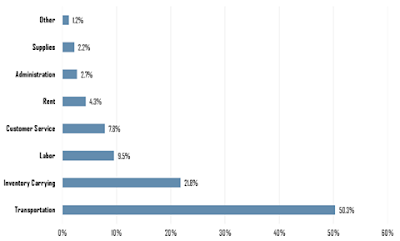
Logistic Costs Breakdown

Logistic Costs Breakdown Generally, logistics costs include 1) Transportation costs 2) Inventory carrying costs 3) Labour Costs 4) Cust...