Thursday, March 17, 2016

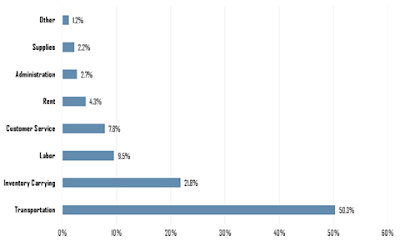
Logistic Costs Breakdown

Logistic Costs Breakdown
Generally, logistics costs include
1) Transportation costs
2) Inventory carrying costs
3) Labour Costs
4) Customer service costs
5) Rent for storage costs
6) Administration costs
7) Other costs

Logistics costs are defined differently by different companies. Some companies do not account interest and depreciation on inventories as logistic costs. Others include the distribution costs of their suppliers or the purchasing costs. In some cases, even the purchase value of the procured goods is included in the logistic costs. So, there is no generic definition of this term but every company needs to define the logistics costs for itself and the KPI’s it will be tracking to lower the costs.
Generally, companies have to do a trade-off between cost and performance while managing logistics costs. This is because the lowest cost transportation may not be the fastest and hence higher costs need to be incurred to provide higher on time delivery and performance. Also, logistics costs is also a function of the type of goods that need to be transported. The mode of transportation for a perishable good will be different from an imperishable good.
Total logistic costs reveal much about the locational dynamics of logistics activities, particularly distribution centers, since they indicate the weight of most important factors. Transportation costs remain the dominant consideration as they account for about half of the logistic costs. Inventory carrying costs are also significant with a share of about one fifth of total costs. They include the costs of holding goods in inventory (capital costs, warehousing, depreciation, insurance, taxation, and obsolescence) and are commonly expressed as a share of the inventory value. Labor costs involve the physical handling of goods, including tasks such as packaging and labeling. Customer service encompasses receiving and processing orders from customers.
Under such circumstances, distributors are willing to pay higher rents to take advantage of a logistics site that offers co-location with an intermodal terminal since this strategy enables them to reduce transportation costs, such as drayage, as well as improve their time responsiveness (lead time). Therefore, while transportation costs remains the most important element of logistics costs and its friction, non-spatial components such as inventory carrying and labor costs, are significant components that will influence locational choice depending on the supply chain.


Source: Establish, Inc. / HWD & Grubb & Ellis Global Logistics.THE GEOGRAPHY OF TRANSPORT SYSTEMS

Total Logistics Costs Tradeoff

Total Logistics Costs Tradeoff
Total logistics costs consider the whole range of costs associated with logistics, which includes transport and warehousing costs, but also inventory carrying, administration and order processing costs. Administration and order processing costs are relative to the total volume being handled. However, for the same volume being handled transport and warehousing costs will vary according to the distribution strategies being adopted. The above graph portrays a simple relationship between total logistics costs and two important cost components; transport and warehousing. Based upon the growth in the shipment size (economies of scale) or the number of warehouses (lower distances) a balancing act takes place between transport costs and warehousing (inventory carrying) costs. There is a cutting point representing the lowest total logistics costs, implying an optimal shipment size or number of warehouses for a a specific freight distribution system. Finding such a balance is a common goal in logistical operations and will depend on numerous factors such as if the good is perishable, the required lead time and the market density.


Source: adapted from McKinnon, A. "The Effects of Transport Investment on Logistical Efficiency", Logistics Research Centre, Heriot-Watt University, Edinburgh, UK.THE GEOGRAPHY OF TRANSPORT SYSTEMSsh, Inc. / HWD & Grubb & Ellis Global Logistics.THE GEOGRAPHY OF TRANSPORT SYSTEMS

Thursday, January 28, 2016

Freight Management ( Cost-Effective Freight Management Outsourcing)

Wednesday, November 4, 2015

Cambodia Ports

Sihanoukville is the main deep-sea port of Cambodia. The Port of Sihanoukville, situated in the Bay of Kompong Som, is the principal and only deep-water maritime port of Cambodia. Kompong Som’s natural advantages include deep water inshore and a degree of natural protection from storms provided by a string of islands across the mouth of the bay. The port was built in 1959 with a total capacity of 1.2 million encompassing the old French-built wharf and adjacent new facilities. The capacity of Sihanoukville port, in its present condition, is estimated at about 950,000 tones per year, excluding POL which has separate facilities. This is about twice its present traffic. The port can accommodate ships of 10,000-15,000 tons deadweight (DWT).

The main access to the port is via a 3 km fairway channel, marked by buoys and leading lights for daylight navigation only. Due to rocky outcrops in the channel, the entrance to the port is restricted to vessels with a draft of less than 8.0-8.5 m. In practice boats of up to about 10,000 DWT can use the port. The port is located 540 nautical miles (1000km) from Singapore.
On the land side, the port is served by National Highway No. 4 (NH4, 240km to Phnom Penh), the main link between Phnom Penh and the coast, and the “New” railway line, completed in 1969, which takes a more southerly route via Kampot. The rail distance to Phnom Penh is 263km. The railway is in poor condition and handled only some 15% of the port traffic in 1993. Aid from the United States is earmarked for an immediate project to resurface the entire length of NH4 as well as to rebuild several bridges between Phnom Penh and Sihanoukville. Roads within Sihanoukville municipality itself are all hard surfaced, albeit of somewhat lesser quality and poorer condition than NH4.
As part of its program to upgrade transport infrastructure in Cambodia, the Asian Development Bank is funding some modest improvements at the port. Immediate investments include the following: new forklift truck for container movement; repair old jetty; replace fenders; replace navigating aids and allow for night navigation; improve container storage yard; and install area lighting to permit night working. There are also reports that French assistance may finance a quayside container crane. (Currently, in the absence of a dedicated crane, the port claims to be able to move 200 containers per 24 hours).
Several warehouses are available providing a total storage area of approximately 6,000 square meters. The two wharfs have a total of five warehouses, one of which is being let out to an oil exploration company. The warehouses have been under-utilized in recent years because of their poor condition, particularly their leaky roofs. Warehouses 1, 2 and 4 are now being repaired under the SRA Project. They have a combined capacity of about 36,000 cube meters. Warehouse 3 was repaired earlier with domestic funds. Container storage and handling is also available. The container yard is 50,000 square meters in area. Regular and direct shipping links with Singapore and Bangkok are in place, with Cambodian-flag shipping (Camtran Ship) being the dominant carrier. In 1993, 15,000 TEU’s (20 food equivalents) passed through Sihanoukville Port. An estimated 80 percent of the containers had origin/destination in Singapore. Behind the warehouses fronting the new wharf, there are railway platforms and tracks as well as a container parking area of some 17,600 square meters. The container area is now being resurfaced under SRAP. Both wharves are also rail-connected.

PHNOM PENH PORT
Phnom Penh depends on access via the Mekong through the delta area of Vietnam. The Phnom Penh port is the country’s traditional river port, accessible to vessels from the South China Sea through Vietnam. Phnom Penh port is located in the city (Tonle Sap river), some 3-4km from its junction with the Mekong. It is some 330 km from the mouth of the Mekong of which about 100 km is in Cambodia and the rest in Vietnam. The distance from Singapore is about 1450km. Vessels of up to 2,000 DWT can use the route without difficulty, and 5,000 DWT boats can pass the entrance to the Mekong (the ‘Main bottleneck) on favorable tides. Regular dredging is necessary at three points in Cambodia for the 5,000 DWT vessels to reach Phnom Penh. The port serves up to 150 ships per year, including 3 Singapore-based cargo vessels which take 10-12 days for the return voyage.

INFRASTRUCTURE
The main-cargo port consists of two sites, generally called Port No. 1 and Port No. 2:
Port No. 1 (the main port) consists of a 184-m long pier built in reinforced concrete, plus three pontoons for sea-going vessels. There are two berths, known as Berths 4 and 5, which can accommodate ships up to 2,000 DWT and 4,000 DWT, respectively. Some 540m of domestic pontoon capacity is available for river ships and barges of up to 100m or 1,800-2,000 tons. The pontoons are served by lighters and junks. There are other berths available for small craft. There are 12 depots of 2,700 sq m and 5,910 tons storage capacity within some 180 m of the berths, plus open storage of some 4,300 sq. m. There is another warehouse complex at Kilomet 6 (Phnom Penh) having 15 sheds with a total capacity of 70,000 tons and 8 sheds of nearly 4,000 tons. Although actual crane capacity is not dear, there are 12 cranes- i.e. two 25-ton, four 16-ton, and six 6.5-ton cranes.
Port No. 2, about 1km south of the main area, consists of two 45 m by 10 m steel pontoons. Due to the long and narrow bridges and the seasonal variation in water levels, these two berths can not be reached by equipment. The capacity of the main port (No. 1) has been estimated at about 150,000 tons per year, a figure already exceeded. This port is now to be rebuilt with the aid of a Japanese grant. The improvements are expected to increase the capacity to some 566,000 tons per year. As an interim measure, Port No. 2 will be rehabilitated under a World Bank credit. When the improvements to Port No. 1 are completed, Port No. 2 could perhaps revert to domestic use (up to 1991, Port No. 2 was for domestic use only).

KOH KONG PORT
Koh Kong is situated near the Thai border and is used by small boats, below 500 DWT.The Koh Kong provincial port is really a system of three ports. Vessels entering Cambodia from Singapore, Malaysia or Thailand call first at Paklong, on the Gulf of Siam about 15 km from the Thai border, for customs clearance and other formalities. Up to 300-ton capacity boats can be accepted, or 500 tons at anchorage. The 300-ton boats can then proceed across the bay to Koh Kong town for unloading or transshipment to smaller vessels if required.
Koh Kong is a small provincial capital with no road access to the rest of Cambodia. Road 43 can only be used (with difficulty) by motor cycles at present. Thus after clearance most boats proceed to another provincial port al Sre Ambel, at an inlet the Kompong Som Bay near Road 4, some 170 km from Phnom Penh. Sre Ambel can only accept 120 to 130-ton boats, however. Traffic that arrives at Koh Kong in larger boats has to be transshipped between vessels at Paklong or Koh Kong town.
Paklong and Koh Kong have quite good but limited facilities and are very congested, particularly Paklong. There is some warehousing in Koh Kong town to support the transshipment activity. Koh Kong is also a quite an important fishing port, from which about 16,000 tons were exported to Thailand in 1993.

OTHER PORTS
Cambodia’s other seaport is at Kampot, 148km from Phnom Penh along Road 3 or 166km by rail. The port is situated in the town on a river bank 4 km from the sea. Of the minor ports, Kampot is the most important coastal facility. It was more important before 1975 when it had better facilities and was able to take vessels of up to 150 tons or more. It is a lighter port, with two main approaches from the sea, one of which has fairway depths of 10 m to within 11 km of the port. The other southern channel could accommodate vessels of less than 4.6m draft. There are three channels through which junks and lighters could enter the river to reach Kampot. A wooden jetty can be used by 30-40 tonne boats. There is a regular trade with Koh Kong, for exchange of goods with Thailand, but Kampot port is not itself used for international traffic.
The other river ports, for example Kompong Cham on the Mekong, are in general also used for domestic traffic only. A small port exists at Kompong Ampil, in Takeo province, where there is a fair amount of trade with Vietnam via a small river that leads into the Bassac, but most boats are only of 25 to 30-ton capacity.

Sunday, October 4, 2015

Economic and reliable sea freight solutions

Are your ocean freight requirements designed around what's best for your individual business needs? At SRMF, we act as consultants, guiding and advising on all elements of the supply chain service, partnering with our customers by achieving an in depth understanding of their requirements.
We provide multiple solutions for ocean freight movements in all major ocean trade lanes, dealing with major carriers on global routes to ensure the availability of space and equipment exactly when you need it.

We offer a complete package of cost effective delivery solutions to match your global supply chain needs:
+Worldwide Ocean Imports & Exports (FCL/LCL) options
-Door/Door
-Door/Port
-Port/Door
-Port/Port
-Buyers Consolidation
+Worldwide Ocean Cross-trade Movements (FCL/LCL)
+Consular Documentation & Legalization Serviaces
+Customs Broker/Brokerage
+Out of Gauge and Project Shipment
+Global agency network

Our dedicated sea freight team will manage all your requirement from pickup point through to final destination, you can rest assured that your cargo is in safe hands.
We work with a network of renowned partners, operation from strategic global locations ensuring we can provide the local knowledge so necessary to deliver a smooth supply chain flow at a cost effective price.

Flow of information is vital in any trade. At SRMF your dedicated Freight Consultant will keep you informed at every step of the process, from collection through to final delivery.

Tuesday, September 15, 2015

ENSURE YOU ONLY PAY WHAT IS RIGHT.


Everyone says they want to improve their bottom line, they are tired of paying too much for their landed costs but don’t change because change means that they have to tell their current supplier that they are tired of being ripped off. So what do they do? They benchmark against other service providers and all of a sudden, they get big discount.


It's not discount, it is proof that you are being ripped off, it is time to stop this and change to the company that will ensure you only pay what is right..


We offer a comprehensive logistics solutions that manages all forms of transport from road and rail to sea and air. Our  purpose-built for our clients and prospective clients, ensuring that every aspect of the transport process is suited to their specific needs.

Always bring good quality content to customer more than just making money. We deliver the good resource to customer, and solve their problem.

Tuesday, September 8, 2015

Logistics as a competitive Weapon

Logistics can create a Competitive Advantage. Logistics may be the best source of competitive advantage for a firm because it is less easily duplicated than other elements of the marketing mix: product, price, and promotion. Consider, for example, forming close, ongoing relationship with carriers or logistics services providers can help give the firm a distinct competitive advantage in speed to the customer, reliability, availability, or other customer service factors.

The power of logistics in achieving an organization's customer service goals and supporting customer satisfaction has received an increased amount of attention in the press. Companies that understand and utilize the potential of logistics as a competitive weapon include logistics as a key component of their strategic planning process. In recognition of the key role of logistics in supporting strategic customer service initiatives.

 I Just want to extract your attention  back to  the succeed military logisticians  "ALEXANDER THE GREAT and Wasn’t THE GREAT ...... LOGISTICIAN !!" he has a famous quote for the logisticians which still carries a lot weight today. He said “My logisticians are a humorless lot … they know if my campaign fails, they are the first ones I will slay.”  I love this quote because it captures the do or die nature of logistics with a funny, but morbid twist. While managers are no longer killing logistics guys, there is still a lot of pressure on the logistics function. 


Why Wasn’t That Great

The problem with Alexander’s management style is that it leads to the wrong behaviors. When the logistics guy is risking his life every time the army falls short, I’m guessing there was a lot of finger pointing, CYA and plain old lying going on.
In such an environment, team work, honesty, morale, and trying out new ideas, were probably in short supply.
The same thing happens today. If the logistics guy is going to be beat up for every problem, they will begin to withhold bad news, cover up issues and shift blame to someone else. When problems get covered up, they obviously don’t get solved.

Open Communication and No Executions

To get the most from your logistics group, you have to develop a culture that encourages open communication and continuous improvement
The foundation of that culture should be honesty. You can’t have good, open communication without honesty. If you shoot the messenger, he will stop bringing bad news. The messenger bringing bad news is actually bringing an opportunity for improvement.
Also begin using metrics or key performance indicators to measure the most important areas. These metrics should point your team to even more opportunities for improvement. Remember, the biggest problem is having no problems to work on.
Encourage experimentation and new approaches. Don’t bet the farm, but take small, calculated risks that potentially uncover better ways of doing business.
"Never slay the logisticians – they are too hard to replace"

Why Was That Great

• He developed alliances with conquered and friendly locals, which enabled his army to be constantly provided magazines of provisions. Many cities surrendered to Alexander’s army before fighting, and subsequently pledged their support and supplies to the Macedonian army.
• He marched along rivers to provide easy access to sea transport, which could deliver tons of supplies compared to 200 pounds per beast of burden. 
• He set up bases to provide shelter and supplies prior to the army’s arrival. These bases were supplied by surrendered cities, ships, or allies.
• He ordered forced, or double-time, marches to conserve supplies in difficult circumstances. This reduced not only the time needed to complete the march but also the need for additional supplies.
• Include logistics in strategic planning 
• Consistently make changes in his organization that were demonstrated to provide specific benefits
• Develop a working knowledge and detailed understanding of his customers and their products, competition, industry, logistics requirements, and technologies and utilize this knowledge, along with other assets, to develop competitive advantages, market share, and profit
• Appoint a single person to lead all logistics functions and participate in strategic planning sessions
• Develop alliances with key suppliers and service providers, accessing their infrastructure by allowing them to entrench themselves in his own company
• Utilize technology and other business tools only to the extent that they further the goals of profitability and competitive advantage
That is exactly how important logistics techniques were for him to win his battles.So, what did he exactly do? Try reading the below & understand if his stratagem were effective.
• He maximized swiftness of action and flexibility of the army by eliminating the usual traveling team of servants, wagons, and spouses from the marching army. 
In other words, this is what he has done
Hence, it can always be agreed that Alexander was the greatest as a logistician for succeeding greatly in his era. Great to also see his strategies are adopted in military as well as business logistics till to date. Now we know that not everything in logistics gets outdated. Of course, no one gets slayed for failing in logistics today. But one who doesn't remain competitive in the industry presently, will surely have his job slayed. Be a winner & win all you can.

Tuesday, July 14, 2015

Choose the right partner.

Believe you have inbound and outbound outsource business of raw material, semi-product, parts and components and assembly for your supply chain business to produce and supply to your customer buyer (retailer, distributor. Consumer), so believe you are looking for reliable partner to minimize your unpleasant situations to improve your lead time with best service and cost effectiveness for your end to end supply chain.

It's all about your business.
Logistics is the lifeline of your business; it's how you service your current clients, reach out to new ones and differentiate yourself from your competition. CAMAJOR understands the importance of logistics to your business and that's why we tailor-make individual solutions for every one of our clients. We take away the operational issues saving you time and money, allowing you to concentrate on sales and supporting you to expand into overseas markets.It's too easy to stay with what you know, try SRMF and see how we can make the difference.

We CAMAJOR we mean what we said, and we do what we said. We need you to trust us, and how you can trust?
For us to translate you how SIMPLY THE BEST we solute your complex logistics and supply chain business: our people will do it to contribute you the trust, then you can verify and distinguish us from whom never ever before to deliver you the trust and satisfaction as you can judge by our performance would better than just read and listen, but to get to know what benefit you and you will deserve (fast and under your budget and schedule.)

*Reduce your logistics spend
*Improve your lead-times
*Reduce your inventory and stock hold
*Understand your specific needs
*Provide you with an unrivalled level of support
*Provide operational simplicity
*Deploy consumer value adding solutions

What will you are facing when waste is created?
We have all heard the phrase " You can't make something out of nothing." Resources are necessary to accomplish anything great or small, but problems arise from using resources unproductively, applying the wrong resources, failing to tap into necessary resources, or directing resources toward the wrong outputs. In each of these instances, waste is created. Cost are incurred, people's time is consumed, opportunities for value creation and growth are lost, and customers are left less than satisfied.

We'll obtain you the full benefits of the improvement of our service links to implement industrial development measures with a long-term view to promote agglomeration of your core business.

Thursday, July 2, 2015

Choosing a Freight Forwarder to Minimize Unpleasant Situations.

Freight forwarder works a company that organizes shipments for individuals or corporations to get goods from the manufacturer or producer to a market, customer or final point of distribution. A forwarder does not move the goods but acts as an expert in supply chain management as they contract with carriers to move the goods through ships, airplanes, trucks and railroads. International freight forwarding requires additional expertise in preparing and processing customs and other documentation and performing activities pertaining to international shipments.
Until about 15 years ago, freight forwarders used to arrange the shipment of goods by contracting carriers, and would also advise on required documentation and customs in the country of destination. Freight Forwarders had to ensure that all aspects of logistics were executed to the satisfaction of all parties concerned, first and foremost the customers. This forced freight forwarders to become full service providers, handling end-to-end logistics such as planning, shipping, tracking, delivery, invoicing as well as managing customers, suppliers, partners, carriers, customs brokers, and government agencies. They deal with international laws and all kinds of rules and regulations, and have to handle multiple currencies, languages, and units of measurement. They must be able to ship any product, from anywhere to anywhere in the world by various modes of transportation.
In order to minimize these unfortunate experiences, you need to be extremely careful on who you are working with as a freight forwarder. You need to be aware that the rate, while important, is not the most important thing when choosing a freight forwarder. Choosing the company with the cheapest freight rates may become much more costly if your shipment gets delayed, held up at customs, lost, or mishandled.
When choosing a freight forwarder, it’s important to consider a number of factors such as how long have they been in freight forwarding business? How responsive are they to you as a customer? How knowledgeable are they about what you’re shipping and the regulations of the country you’re shipping to? Will they know what to do if something goes wrong?
A freight forwarder or shipping company that has not been in business long often lacks the experience and know-how to handle all the little details that can complicate international shipping in order to ensure a smooth import or export experience. In order not to put your shipments at risk, always choose a freight forwarder with long time experience and service versus cost..

We don't want to be an excellence but ability to provide the unique service.


Wednesday, April 1, 2015

How Currency Changes Affect Imports and Exports


Learn about how currency changes can affect imports and exports. Find out how this affects you. Discover what happens when a dollar is strong compared to other currencies and what happens when it is weak.
Imports and Exports
When you hear the terms 'imports' and 'exports,' you may think of some complicated and elaborate business you saw on a television show a few months back. You may simply think these terms sound dull and have little impact on your everyday life. The bottom line is that these two terms have a dramatic impact on the economy and the selection of everyday goods that you are able to purchase.
When you walk into large electronic stores, you expect to see top electronic brands from across the world, not just electronics made in your neighboring states. Can you imagine if you walked into a popular electronics store and they only had two television brand choices? You would probably end up paying more money and might not even like the choices you had to choose from. These products from other countries (imports) provide more choices for you and can also help you save money.
One of the biggest factors that influences imports and exports is the value of currencies between trading countries. Let's explore how the value of currencies can impact businesses and directly affect the amount of goods and services you may have to choose from when you go shopping.
Currency Changes and Imports
Imports are goods that are produced in a foreign country but sold in a home country. When people in one country demand products from firms in another country, they must enter into another market first to buy that nation's currency. Once this currency is exchanged, they can then purchase the product.
For example, if you owned a chain of dollar stores and wanted to purchase various products from large Chinese corporations, you often can't just send a check in American dollars to the companies in China. Chinese companies would want to be paid in their own currency. As a result, you would have to go into a foreign exchange market and buy the Chinese currency with the American dollars so that you could pay for your goods.
When the U.S. dollar is strong compared to many other countries' currencies, imports are less expensive. This is because every American dollar you have will buy more corresponding foreign currency. So when you go to pay the Chinese companies in their own currency, you won't have to spend as many dollars to do it! As a result, this will lead to increased demand for imported products and the currency needed to purchase them.
On the other hand, if you are importing and your local currency depreciates in value or becomes weak, then the products you are importing become more expensive. It now costs you more U.S. dollars to purchase foreign currency, making those products in Japan and China more expensive. A strong dollar or currency leads to higher imports. A weak dollar or currency to lower imports.
Currency Changes and Exports
To review quickly, exports are goods that are produced in a home country but sold to foreign countries. For example, you may have a business that makes and sells your own clothing line in the U.S. In order to increase your sales, you decide to enter and market your clothes to England and Europe. All of the sales and shipments of your clothes to England and Europe are exports.
So how does a strong dollar affect your export business? If you are exporting and your local currency becomes strong or appreciates in value, then your products become more expensive for your buyers in England and Europe. Since you want to be paid in U.S. dollars, they will have to exchange their pounds or Euros for U.S. dollars. When your European business partners can't purchase as many dollars with their money, that makes your products more expensive. As a result, they will likely buy less of your product.
When the value of the dollar depreciates or falls, your European partners can now buy more U.S. dollars with their currency, and the price of your goods seems cheaper to them. This will increase your exports and overall sales!

Thursday, March 19, 2015

You Need To Know About Reverse Logistics

Have you considered implementing reverse logistics to get more out of your company’s time and resources? Reverse logistics can help you optimize your supply chain and reduce waste. Keep reading to learn more. What does the term “reverse logistics” mean? ‘Reverse logistics’ is a term used to describe the process of returning an item from its typical final destination back to the manufacturer in order to properly dispose of the item or extract value from the item. Imagine, for a moment, that your company makes and sells coffee mugs. Traditional logistics describe the process of manufacturing, packaging, shipping, and selling the items to a customer. This process begins at the manufacture and ends at the consumer. Reverse logistics describe the opposite process. This trail begins at the customer and makes its way back toward the manufacturer. For example, if the customer received a defective coffee mug, reverse logistics would describe the process of shipping the product back to the company, testing the product, and repairing the product or recycling the materials. This process helps you make the most out of the materials you used instead of letting them end up in a landfill. What can reverse logistics do for my business? Good reverse logistics can keep your customers happy and save your company time, resources, and money. Bad reverse logistics can frustrate customers and waste resources. A good process for returning unwanted or damaged items should be efficient and simple—especially for your customers. An inefficient process will waste resources on shipping and damage your reputation with customers. Efficient reverse logistics help you retain customers, protect the environment, and reduce your costs. How can I implement reverse logistics? To implement efficient reverse logistics, you need to make the most of your regular processes. Use best practices for logistics to optimize your supply chain network, customer communication, and shipping strategies. 
Once you’ve optimized your traditional processes, you can hone your reverse logistics process by using reusable packaging, consolidating shipping, and improving customer communication. Reverse logistics can help your business reduce waste and save money.

Thursday, March 12, 2015

LOGISTICS MANAGEMENT

AN INTRODUCTION TO SUPPLY CHAIN MANAGEMENT
Logistics Management is that part of Supply Chain Management that plans, implements, and controls the efficient, effective, forward, and reverse flow and storage of goods, services, and related information between the point of origin and the point of consumption in order to meet customers’ requirements.
A supply chain is a network of facilities and distribution options that performs the functions of procurement of materials, transformation of these materials into intermediate and finished products, and the distribution of these finished products to customers. Supply chains exist in both service and manufacturing organizations, although the complexity of the chain may vary greatly from industry to industry and firm to firm.
Below is an example of a very simple supply chain for a single product, where raw material is procured from vendors, transformed into finished goods in a single step, and then transported to distribution centers, and ultimately, customers. Realistic supply chains have multiple end products with shared components, facilities and capacities. The flow of materials is not always along an arborescent network, various modes of transportation may be considered, and the bill of materials for the end items may be both deep and large.
Traditionally, marketing, distribution, planning, manufacturing, and the purchasing organizations along the supply chain operated independently. These organizations have their own objectives and these are often conflicting. Marketing's objective of high customer service and maximum sales dollars conflict with manufacturing and distribution goals. Many manufacturing operations are designed to maximize throughput and lower costs with little consideration for the impact on inventory levels and distribution capabilities. Purchasing contracts are often negotiated with very little information beyond historical buying patterns. The result of these factors is that there is not a single, integrated plan for the organization---there were as many plans as businesses. Clearly, there is a need for a mechanism through which these different functions can be integrated together. Supply chain management is a strategy through which such an integration can be achieved.
Supply chain management is typically viewed to lie between fully vertically integrated firms, where the entire material flow is owned by a single firm, and those where each channel member operates independently. Therefore coordination between the various players in the chain is key in its effective management. Cooper and Ellram [1993] compare supply chain management to a well-balanced and well-practiced relay team. Such a team is more competitive when each player knows how to be positioned for the hand-off. The relationships are the strongest between players who directly pass the baton, but the entire team needs to make a coordinated effort to win the race.
SUPPLY CHAIN DECISIONS
We classify the decisions for supply chain management into two broad categories -- strategic and operational. As the term implies, strategic decisions are made typically over a longer time horizon. These are closely linked to the corporate strategy (they sometimes {\it are} the corporate strategy), and guide supply chain policies from a design perspective. On the other hand, operational decisions are short term, and focus on activities over a day-to-day basis. The effort in these type of decisions is to effectively and efficiently manage the product flow in the "strategically" planned supply chain. There are four major decision areas in supply chain management:
Location.
Production.
Inventory.
Transportation (Distribution).
And there are both strategic and operational elements in each of these decision areas. Location Decisions The geographic placement of production facilities, stocking points, and sourcing points is the natural first step in creating a supply chain. The location of facilities involves a commitment of resources to a long-term plan. Once the size, number, and location of these are determined, so are the possible paths by which the product flows through to the final customer. These decisions are of great significance to a firm since they represent the basic strategy for accessing customer markets, and will have a considerable impact on revenue, cost, and level of service. These decisions should be determined by an optimization routine that considers production costs, taxes, duties and duty drawback, tariffs, local content, distribution costs, production limitations, etc. (See Arntzen, Brown, Harrison and Trafton [1995] for a thorough discussion of these aspects.) Although location decisions are primarily strategic, they also have implications on an operational level.
PRODUCTION DECISIONS
The strategic decisions include what products to produce, and which plants to produce them in, allocation of suppliers to plants, plants to DC's, and DC's to customer markets. As before, these decisions have a big impact on the revenues, costs and customer service levels of the firm. These decisions assume the existence of the facilities, but determine the exact path(s) through which a product flows to and from these facilities. Another critical issue is the capacity of the manufacturing facilities--and this largely depends the degree of vertical integration within the firm. Operational decisions focus on detailed production scheduling. These decisions include the construction of the master production schedules, scheduling production on machines, and equipment maintenance. Other considerations include workload balancing, and quality control measures at a production facility.
INVENTORY DECISIONS
These refer to means by which inventories are managed. Inventories exist at every stage of the supply chain as either raw materials, semi-finished or finished goods. They can also be in-process between locations. Their primary purpose to buffer against any uncertainty that might exist in the supply chain. Since holding of inventories can cost anywhere between 20 to 40 percent of their value, their efficient management is critical in supply chain operations. It is strategic in the sense that top management sets goals. However, most researchers have approached the management of inventory from an operational perspective. These include deployment strategies (push versus pull), control policies --- the determination of the optimal levels of order quantities and reorder points, and setting safety stock levels, at each stocking location. These levels are critical, since they are primary determinants of customer service levels.
TRANSPORTATION DECISIONS
The mode choice aspect of these decisions are the more strategic ones. These are closely linked to the inventory decisions, since the best choice of mode is often found by trading-off the cost of using the particular mode of transport with the indirect cost of inventory associated with that mode. While air shipments may be fast, reliable, and warrant lesser safety stocks, they are expensive. Meanwhile shipping by sea or rail may be much cheaper, but they necessitate holding relatively large amounts of inventory to buffer against the inherent uncertainty associated with them. Therefore customer service levels, and geographic location play vital roles in such decisions. Since transportation is more than 30 percent of the logistics costs, operating efficiently makes good economic sense. Shipment sizes (consolidated bulk shipments versus Lot-for-Lot), routing and scheduling of equipment are key in effective management of the firm's transport strategy.
SUPPLY CHAIN MODELING APPROACHES
Clearly, each of the above two levels of decisions require a different perspective. The strategic decisions are, for the most part, global or "all encompassing" in that they try to integrate various aspects of the supply chain. Consequently, the models that describe these decisions are huge, and require a considerable amount of data. Often due to the enormity of data requirements, and the broad scope of decisions, these models provide approximate solutions to the decisions they describe. The operational decisions, meanwhile, address the day to day operation of the supply chain. Therefore the models that describe them are often very specific in nature. Due to their narrow perspective, these models often consider great detail and provide very good, if not optimal, solutions to the operational decisions.
To facilitate a concise review of the literature, and at the same time attempting to accommodate the above polarity in modeling, we divide the modeling approaches into three areas --- Network Design, ``Rough Cut" methods, and simulation based methods. The network design methods, for the most part, provide normative models for the more strategic decisions. These models typically cover the four major decision areas described earlier, and focus more on the design aspect of the supply chain; the establishment of the network and the associated flows on them. "Rough cut" methods, on the other hand, give guiding policies for the operational decisions. These models typically assume a "single site" (i.e., ignore the network) and add supply chain characteristics to it, such as explicitly considering the site's relation to the others in the network. Simulation methods is a method by which a comprehensive supply chain model can be analyzed, considering both strategic and operational elements. However, as with all simulation models, one can only evaluate the effectiveness of a pre-specified policy rather than develop new ones. It is the traditional question of "What If?" versus "What's Best?".
ADVANTAGE OF SUPPLY CHAIN MANAGEMENT
Reduces transportation management time and costs.
Increases profit margins and overall profitability.
Integrates transportation procurement, planning and execution.
Improves on - time deliveries and customer service.
Enables global supply visibility and maximum efficiency for competitive advantage.
Strengthens relationships with suppliers and carriers.
Enables the movement of goods across modes and around the globe.

Friday, March 6, 2015

Why All Businesses, Big or Small, Rely so much on LOGISTICS?

Are you starting to see why logistics is so crucial to the success of your business?

4 main areas of logistics:

Logistics doesn’t begin and end with one process or organization.  In other words, it doesn’t take place all under one roof. There are

1.       Procurement: This is the first step in the supply chain, and it isn’t production. First, you need to conduct market research, make purchasing decisions, select suppliers, and negotiate contracts. What makes procurement run smoothly? Logistics.

2.       Production: Now you’ve got to design and produce the goods. This means organizing and planning (logistics) the layout and production of your product so that the whole process is streamlined and efficient.

3.       Distribution: Now your goods and services are ready to be distributed to your customers. You’re dealing with processing, storing, and transporting; while documenting every step of the way.

4.       Disposal Logistics: It doesn’t end with the consumer. Logistics is obsessed with reducing cost and eliminating waste. With disposal logistics, also called reverse logistics, you look for ways to reuse and recycle scraps and byproducts of the supply chain.

Whether you’re dealing with apparel, software or something else , you need logistics. A large corporation might deal with all four areas of logistics, but even a small company usually works with suppliers and distribution.

WHY INCOTERM IS IMPORTANT, AND HOW ITS SAVVY ARE YOU?

The Incoterms, or International Commercial Terms are a series of pre-defined commercial terms published by the International Chamber of Commerce. These terms are used widely in International commercial transactions and procurement processes.
It is important for every company to have the Incoterms at the forefront of their practices. And to help you do that effectively, here are a few of the basics.

Understanding the rules
First off, you should understand that there are 11 rules in the most recent update, and these rules are divided into two sections. The first is for any mode of transport, and the second is for transportation through water.

Understanding which set of rules you must abide will help you to ship internationally legally and without too much hassle. These rules determine the way in which proceedings must occur, including: 

·         Where the goods must be sold or exchanged
·         Who pays for the transportation of the goods
·          What risks will be assumed, and by whom

For more information on the individual rules Incoterm, you can check out the International Chamber of Commerce website. Understanding these rules can help small businesses to be more successful and to decrease their risks in international trades.

Understanding the importance of the Incoterms

Once you have the rules in check, it is important to understand what the Incoterms can do for you.  Overall, these terms have all been created to ensure that international business ventures go over smoothly.
Because so many barriers (language barriers among others) are in place in international trade, a common set of laws, like the Incoterms, are essential to fair trade. That means that the main benefit of the Incoterms for your business is decreased risk in your international transactions.
These rules can decrease confusion and make international trades much simpler for small business.


We SRMF  will help clients understand the Incoterms and to make their international trades successfully. Contact us today and see how we can help you understand the Incoterms and be more successful.

Tuesday, February 17, 2015

CAMAJOR a master co-loader


CAMAJOR a master co-loader with major airlines and shipping lines,  is your dreamed One Stop Logistics services Mall. We have the dedicated team of staff who are the customer orientated freight forwarding professionals having rich and varied experience of both Air and Sea freight management with a vision to provide you with global transport Solutions.


Logistic Costs Breakdown

Logistic Costs Breakdown Generally, logistics costs include 1) Transportation costs 2) Inventory carrying costs 3) Labour Costs 4) Cust...